
Wisconsin Probate Court Records give you direct access to wills, estate inventories, final distribution orders, and other key legal documents filed in county circuit courts across the state. These records follow strict rules under Wisconsin Statutes §§ 851–882, which require the original will to be filed within 30 days of death and a full estate inventory submitted within six months by the personal representative. Whether you’re a genealogist, attorney, researcher, or family member, these files offer reliable details about dates of death, property holdings, heirs, creditors, and asset values. Many counties now digitize probate indexes as PDF images starting from the 1890s, making historical research faster and more accurate. The statewide court system also provides online tools to search docket entries, view case status, and download certified copies—all designed to help users find what they need quickly and legally.
How to Access Wisconsin Probate Court Records
Start your search at the county clerk’s office where the person lived when they died. Each of Wisconsin’s 72 circuit courts keeps original probate filings, including wills, petitions, inventories, and final judgments. Most counties allow walk-in visits during business hours, and many provide free public terminals to view scanned documents. For older or microfilmed records, you may need to schedule an appointment. Online portals like the Wisconsin Court System’s case search tool let you look up cases by name, case number, or filing date. Some counties, such as Rock County, offer free PDF downloads of probate documents with advanced filters for estate value or judge assignment. Always bring valid ID and know the decedent’s full name and approximate date of death to speed up your request.

Types of Documents Found in Wisconsin Probate Records
Wisconsin Probate Court Records contain several core document types. The original will lists beneficiaries, names an executor, and outlines how assets should be distributed. The estate inventory itemizes all property—real estate, bank accounts, vehicles, personal belongings—and assigns monetary values. Creditor claims show debts owed by the estate, while heir certifications confirm legal heirs and their relationships to the deceased. Final distribution orders detail how assets were transferred after debts and taxes were paid. These records often include farm acreage descriptions, business interests, and life insurance payouts. Genealogists use them to verify marriages, children, and family lines. Attorneys rely on them to resolve disputes or validate claims. All documents are public unless sealed by court order.
Statewide Online Search Tools for Probate Records
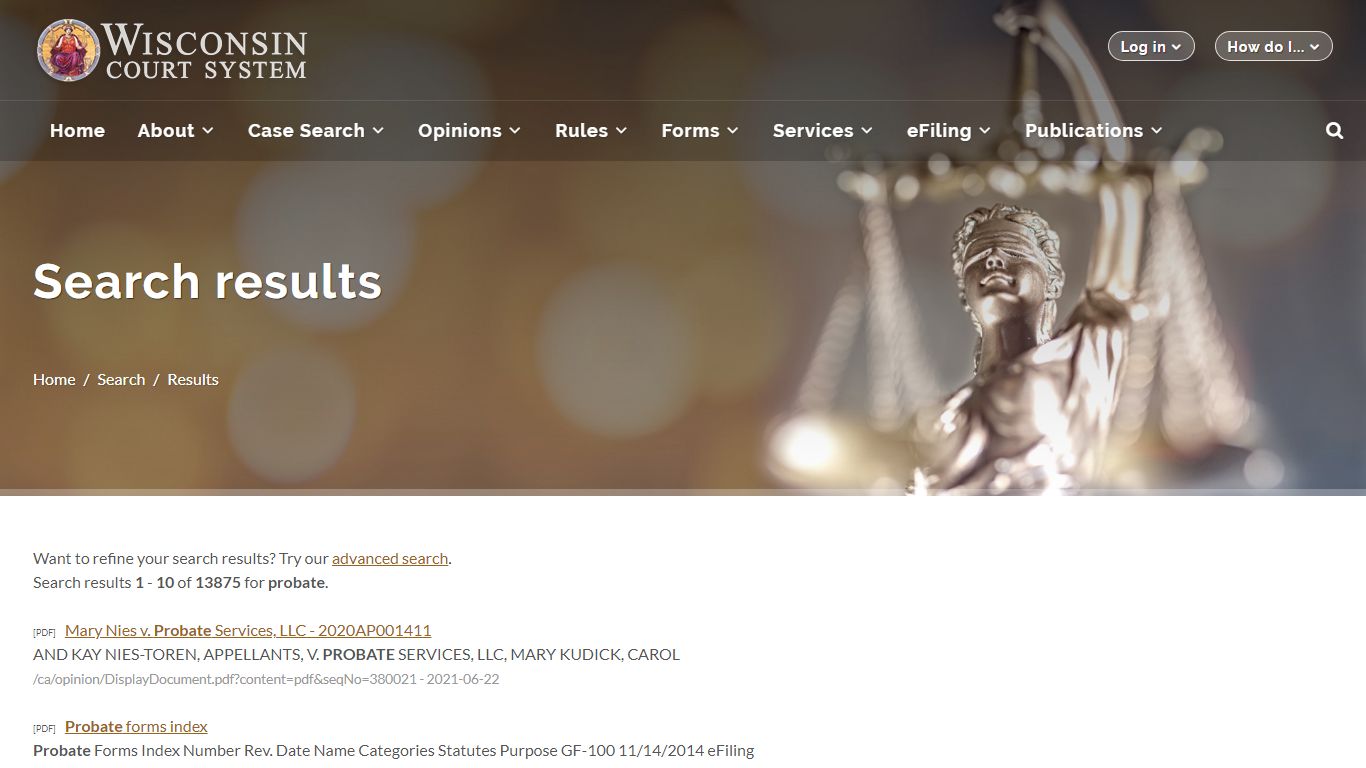
The Wisconsin Court Records Management Committee runs a centralized portal that aggregates docket entries for probate, civil, and criminal cases. You can search by case number, party name, or filing year. Results show the presiding judge, petition date, document types, and current status—active, closed, or appealed. For example, the 2020 case Probate Services, LLC v. Kay Nies-Toren (Case No. 2020 AP 001411) is fully searchable and includes links to motions, orders, and briefs. The system also tracks trends, like average processing times for probate cases. In 2020, Wisconsin courts opened 631,296 new cases across all divisions, showing high public reliance on these services. Users can filter results by county, document type, or date range to narrow searches efficiently.
County-Specific Probate Offices and Services
Each Wisconsin county operates its own probate office with unique rules, fees, and hours. Milwaukee County charges $1.00 per page for wills and inventories and allows walk-in access to open files Monday through Friday from 8 a.m. to 4:30 p.m. For closed or microfilmed records, call (414) 278-4452 to book a two-hour appointment. Rock County offers free online probate searches with filters for estate value over $250,000 and instant PDF downloads. Fond du Lac County’s Probate Office, located at 160 South Macy Street, provides certified copies and filing guidance; contact Brenda at (920) 906-4743 or Emily at (920) 929-3084. Most offices accept cash, check, or credit card for copy fees, which typically range from $1.00 to $1.25 per page. Always confirm hours and requirements before visiting.
Understanding Confidential vs. Open Probate Files
Not all Wisconsin Probate Court Records are public. The Wisconsin Register in Probate Association (WRIPA) manages both open and confidential files. Open records include wills, inventories, and final distributions that anyone can view. Confidential files may contain sensitive data like minor guardianship details, mental health records, or sealed adoption information. To access a confidential record, you must file a formal petition with the circuit court and sometimes obtain a protective order. WRIPA’s online portal lets you search open cases by county or case number and view abstracts with filing dates, representative names, and estate values. If a record is marked “sealed,” contact the clerk’s office for instructions on requesting access. This system protects privacy while ensuring transparency for standard estate matters.
Fees, Copy Requests, and Certified Documents
Copying Wisconsin Probate Court Records involves small fees. WisconsinPublicRecords.org charges $1.25 per standard page and $4.00 for expedited service. Milwaukee County sets its rate at $1.00 per page for wills and inventories. Certified copies—required for legal proceedings—may cost extra and usually take 3–5 business days. You can request copies in person, by mail, or online through county portals. Include the decedent’s full name, case number (if known), document type, and your contact information. Payment methods vary: some offices accept only cash or check, while others take credit cards. Expedited processing is available for urgent needs like court deadlines. Always ask for a receipt and keep a copy of your request for your records.
Using Probate Records for Genealogy and Family History
Genealogists rely heavily on Wisconsin Probate Court Records to build family trees and confirm relationships. These documents list spouses, children, parents, and alternate beneficiaries with precise names and dates. Farm acreage descriptions, bank account numbers, and real estate deeds help trace property ownership across generations. FamilySearch.org recommends starting at the county level because most original records stay with the local circuit court. Their catalog includes digitized probate indexes from the 1890s onward, microfilm locations, and direct links to all 72 county offices. Researchers can cross-reference probate filings with census data, birth certificates, and marriage licenses to verify identities. Even if a will is lost, inventory sheets and creditor notices often survive and provide valuable clues about family structure and wealth.
Legal Framework: Wisconsin Probate Laws and Procedures
Wisconsin Statutes Chapters 851 through 882 govern every step of probate. The personal representative must post a bond (unless waived in the will), notify creditors, and publish a notice in a local newspaper. They must file the initial petition, submit a full inventory within six months, and finalize distributions after debts are paid. The Wisconsin Register in Probate Association publishes a free handbook called “A Personal Representative’s Guide to Informal Estate Administration in Wisconsin,” which walks users through forms, fees, and timelines. Common forms include Petition for Administration (Form WI-202) and Final Account (Form WI-315). Filing fees range from $30 for small estates under $50,000 to $150 for estates over $500,000. These laws ensure fairness, transparency, and efficiency in handling deceased persons’ affairs.
Technology and Case Management: CCAP System Overview
The Consolidated Court Automation Programs (CCAP) system powers Wisconsin’s court operations. It handles electronic filing, docket tracking, automated notices, and real-time reporting. In 2020, circuit courts opened 631,296 new cases and closed 608,730, reflecting a slight drop from 2019 due to pandemic delays. CCAP reduces paperwork, speeds up probate processing, and improves public access. Attorneys and clerks use it to file documents, check deadlines, and monitor case progress. The public sees cleaner, faster searches and more reliable data. This system supports all 72 counties with consistent software, training, and security protocols. It also feeds into the statewide case search portal, ensuring users get up-to-date information on any probate matter filed since 1995.
Free Public Access Terminals and Online Databases
Every Wisconsin circuit court clerk’s office provides free public terminals to view probate records. These computers let you search dockets, print documents, and save files to USB drives. No login or fee is required for basic viewing. Online databases like https://wcca.wicourts.gov/ aggregate case numbers, parties, and document types statewide. You can filter by “Probate” or “Estate” to see only relevant filings. Some counties, like Rock County, offer full PDF downloads at no cost. Others charge minimal fees for certified copies. The terminals are available during regular business hours, usually 8 a.m. to 4:30 p.m., Monday through Friday. Staff are available to assist with searches but cannot provide legal advice. This free access ensures everyone can research estate matters without financial barriers.
Common Challenges and How to Overcome Them
Finding Wisconsin Probate Court Records can be tricky if the decedent lived in multiple counties or died before 1900. Start with the county where they owned property or last resided. If no record appears, check neighboring counties or contact the Wisconsin Historical Society for archived files. Misspelled names, outdated spellings, or name changes can hide records—try searching with alternate spellings or initials. For sealed cases, submit a written request explaining your relationship to the estate and your need for access. If a will was never filed, look for letters of administration or intestacy records. Always double-check dates: some counties only digitize records from the 1980s forward. When in doubt, call the clerk’s office—they can guide you to the right file or explain why a record might be missing.
Tips for Researchers, Attorneys, and Family Members
Researchers should begin with the statewide case search tool, then visit the county clerk for original documents. Attorneys can use CCAP to track active cases, file motions, and monitor deadlines. Family members seeking inheritance details should request the final distribution order and inventory sheet. Always bring photo ID and proof of relationship (like a birth certificate) if claiming a copy for legal use. Keep notes on case numbers, filing dates, and judge names—they help if you need to appeal or follow up. Use free resources like FamilySearch and WRIPA before paying for copies. If you’re researching ancestors, combine probate records with land deeds, tax rolls, and church registries for a complete picture. Patience and persistence pay off—most records are findable with the right approach.
Related Legal Resources and Support Services
Beyond probate records, Wisconsin offers tools for broader legal research. The Wisconsin Court System website includes self-help guides, downloadable forms, and fee schedules. The Register in Probate Association provides training for new representatives and publishes best practices. For genealogy, FamilySearch and the Wisconsin Historical Society hold microfilm and digitized archives. If you need help interpreting a will or inventory, consult a probate attorney or legal aid organization. Many counties also host free workshops on estate planning and probate basics. These resources complement court records and help users understand their rights and responsibilities.
Contact Information for Key Offices
For general questions about Wisconsin Probate Court Records, contact the Wisconsin Court System at (608) 266-1880 or visit https://www.wicourts.gov. The Wisconsin Register in Probate Association can be reached at http://www.wripa.org. Milwaukee County Probate Court: (414) 278-4452, 8 a.m.–4:30 p.m., Monday–Friday. Fond du Lac County Probate Office: (920) 906-4743 (Brenda) or (920) 929-3084 (Emily), 160 South Macy Street, Fond du Lac, WI 54935. Rock County Courts offer online searches at https://unicourt.com/courts/state/rock-county-courts-33467/probate. All offices welcome phone inquiries during business hours.
Frequently Asked Questions About Wisconsin Probate Court Records
People often ask how to find probate records, whether they’re free, and what information they contain. Below are clear, direct answers based on current Wisconsin law and court practices. These responses address real user concerns and help avoid common mistakes.
How do I request a certified copy of a will in Wisconsin?
To get a certified copy of a will, go to the circuit court clerk’s office in the county where the person died. Bring the decedent’s full name, date of death, and your photo ID. If you know the case number, include it—it speeds up the process. Most counties charge $1.00 to $1.25 per page for standard copies and more for certified versions. Certified copies have an official stamp and are needed for banks, real estate transfers, or court filings. You can usually request them in person, by mail, or online. Processing takes 1–5 business days. If the will is part of a sealed case, you’ll need court permission first. Always ask for a receipt and keep a copy of your request.
Are Wisconsin probate records available online for free?
Yes, many Wisconsin probate records are free to view online. The statewide case search portal at https://wcca.wicourts.gov/ lets you look up docket entries, filing dates, and document types at no cost. Some counties, like Rock County, allow free PDF downloads of wills and inventories. Others provide free public terminals in the clerk’s office. However, certified copies usually require a small fee. Historical records before the 1980s may only be available on microfilm or in person. FamilySearch.org also offers free access to digitized probate indexes from the 1890s onward. While viewing is often free, printing or certifying documents typically costs money. Always check the specific county’s website for their policies.
What happens if a will was never filed in Wisconsin?
If a will was never filed, the estate is handled as intestate, meaning state law decides who inherits. The court appoints an administrator (not an executor) to manage the estate. You can still find records—look for “Letters of Administration” or “Intestacy Proceedings” in the probate docket. These documents list heirs, creditors, and asset distributions just like a will-based case. Contact the county clerk where the person lived to search for these filings. Sometimes, a will is found later and filed posthumously—check recent dockets or ask the clerk to search by name. Even without a will, family members can petition to open an estate and claim inheritance rights under Wisconsin law.
Can I access probate records if I’m not a family member?
Yes, most Wisconsin probate records are public and open to anyone. You don’t need to be a relative to view wills, inventories, or final orders. However, confidential files—like those involving minors or sealed by court order—are restricted. To access them, you must file a petition with the circuit court and show good cause. For open records, simply visit the clerk’s office or use the online search tool. Bring ID and the decedent’s name. Researchers, journalists, and historians routinely use these records. Just remember: while viewing is allowed, copying or certifying may involve fees. Always respect privacy and use information responsibly.
How far back do Wisconsin probate records go?
Wisconsin probate records date back to the 1830s, when the territory was first organized. However, most counties only digitized records from the 1890s onward. Older files may exist on microfilm or in paper archives. The Wisconsin Historical Society and FamilySearch hold many pre-1900 probate documents. Some counties destroyed early records due to fires or floods, so availability varies. For 20th-century cases, nearly all records are preserved. The statewide online search covers filings since 1995. For anything older, plan to visit the county clerk or request microfilm scans. Always call ahead—some offices require appointments for historical research.
What should I do if I can’t find a probate record in Wisconsin?
If you can’t find a probate record, try searching in neighboring counties or under alternate spellings of the name. The person may have lived or owned property in multiple places. Check the Wisconsin Historical Society, FamilySearch, or local genealogical societies for archived files. If the estate was small (under $50,000), it might have been settled without formal probate—look for small estate affidavits instead. Contact the clerk’s office directly; they can check offline indexes or explain why a record might be missing. Sometimes, cases are misfiled or labeled under a different case type. Persistence and cross-referencing with other records (like land deeds or obituaries) often lead to success.
Are probate records the same as death certificates in Wisconsin?
No, probate records and death certificates are different. A death certificate is issued by the state vital records office and confirms the date, cause, and place of death. Probate records are court documents that show how the person’s estate was handled after death—including wills, asset lists, and heir distributions. You need both for full legal and genealogical research. Death certificates cost around $20 and come from the Wisconsin Department of Health Services. Probate records come from county circuit courts and may be free to view. While related, they serve separate purposes: one proves death, the other proves inheritance rights.